
Blog
How to Get a Job at a Startup Without Sending 100 Applications
Early-stage startups hire through conversations, not job boards. How to find founders who are hiring, stand out, and land a startup job.
S.U.M Team · 2026-11-24
Short answer: to get a job at an early-stage startup, skip the application pile and get into conversations with founders. Pick the kind of company you want, show proof of what you can do, message founders directly with something specific, and use founder communities and startup matching apps like S.U.M to meet founders who are actively hiring.

Why applications don't work well for startup jobs
Large companies have recruiters, applicant systems and rounds of screening. A startup with five people has none of that. The founder is often the recruiter, the hiring manager and the person reading your message, usually late at night between other jobs.
That is why so many early roles are never posted. Founders hire people they have met, people someone recommended, or people who showed up with something useful. Instead of competing in a pile, you want to start a conversation.

Step 1: Decide what kind of startup you want
"Any startup" is too broad to act on. Narrow it:
- Stage: an idea-stage team, a company with early users, or one that has raised a seed round?
- Domain: what problems or industries genuinely interest you?
- Role: what would you own on day one?
- Location: in person in a specific city, or remote?
A clear target makes every next step faster.
Step 2: Build proof, not just a résumé
Founders want to know you can do the work with little direction. Strong proof looks like:
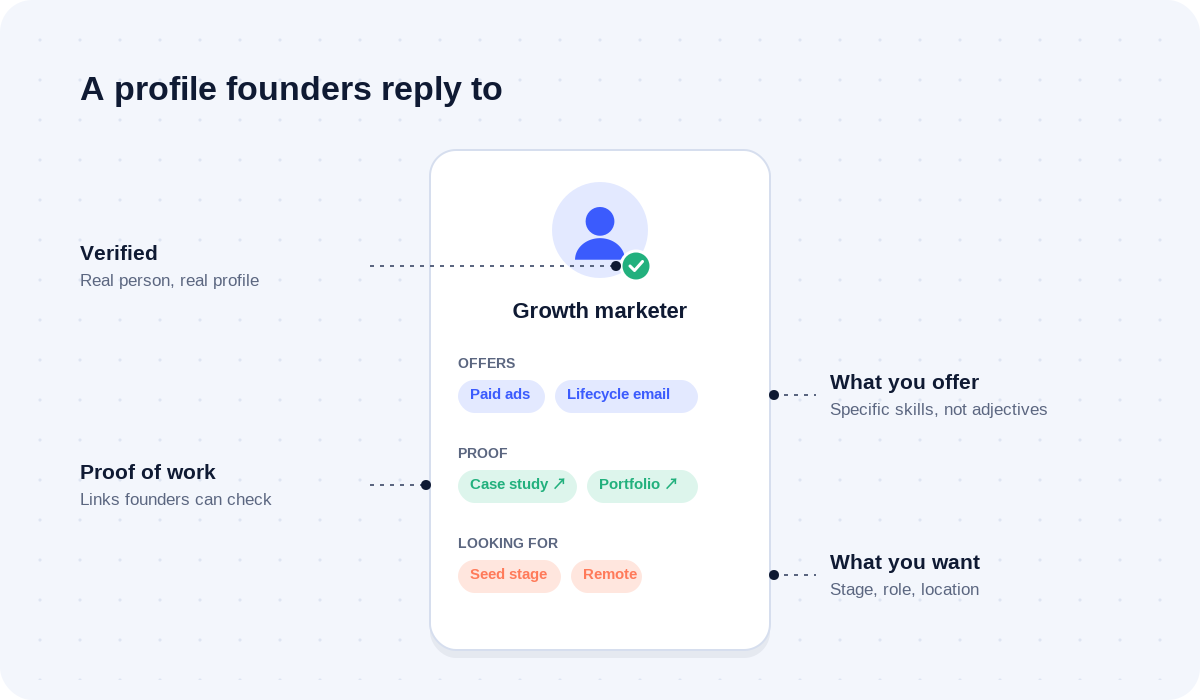
- A portfolio, GitHub, case studies or writing samples
- Results from past roles, described plainly ("grew sign-ups", "shipped the payments flow")
- Side projects you finished
- A small piece of work done for their product: a teardown, a design idea, a growth experiment
One specific example beats a page of adjectives.
Step 3: Find founders who are hiring
Places to look:
- Founder events and demo nights. Founders often mention they are hiring when they present.
- Communities in your field. Founders hang out where their future team does.
- Founders' own posts. Many announce roles on their personal accounts before anywhere else.
- Accelerator portfolios. Recently funded teams are often hiring.
- Startup matching apps. Platforms where founders mark that they are hiring let you skip the guesswork.
Step 4: Start the conversation well
A good first message is short:
- One line on what you noticed about their product.
- One line on what you would do in the role.
- One piece of proof, with a link.
- A simple ask: a 20-minute call.
Then follow up once, politely, if you don't hear back within a week.
Step 5: Ask the right questions before you say yes
Early-stage jobs come with more uncertainty, so ask openly about how long the company's money will last, what your first few months should achieve, how much equity you would get and on what vesting schedule, and how the founders make decisions. Good founders respect these questions.
How S.U.M helps you get hired at a startup
S.U.M, the verified startup matching app, is built for this kind of hiring. You pick the Get hired lane, and S.U.M shows you founders who are hiring, by place and intent. Your profile shows what you offer and what you are looking for. There are no job posts and no applications: when you and a founder both like each other's profile, you match and talk directly over chat and video.
Every member verifies with LinkedIn or Instagram, and no paid plan can buy a higher spot in anyone's deck, so a strong profile is what gets you seen.
S.U.M is in early access. Join the waitlist with the Get hired lane; the iOS, Android and web apps are on the way.
Related: Hire for your startup without job posts · Find a co-founder · How S.U.M works
Related lane: Get hired